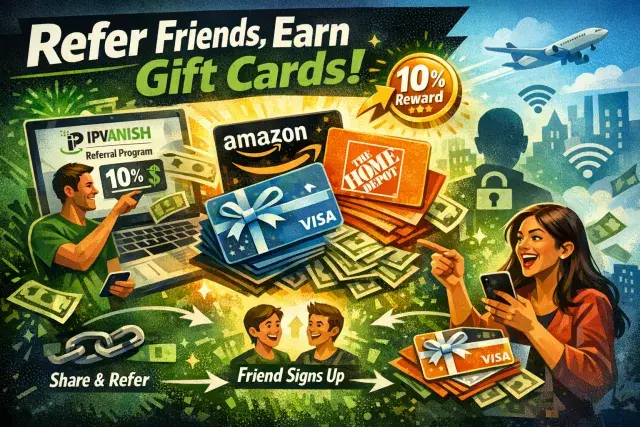
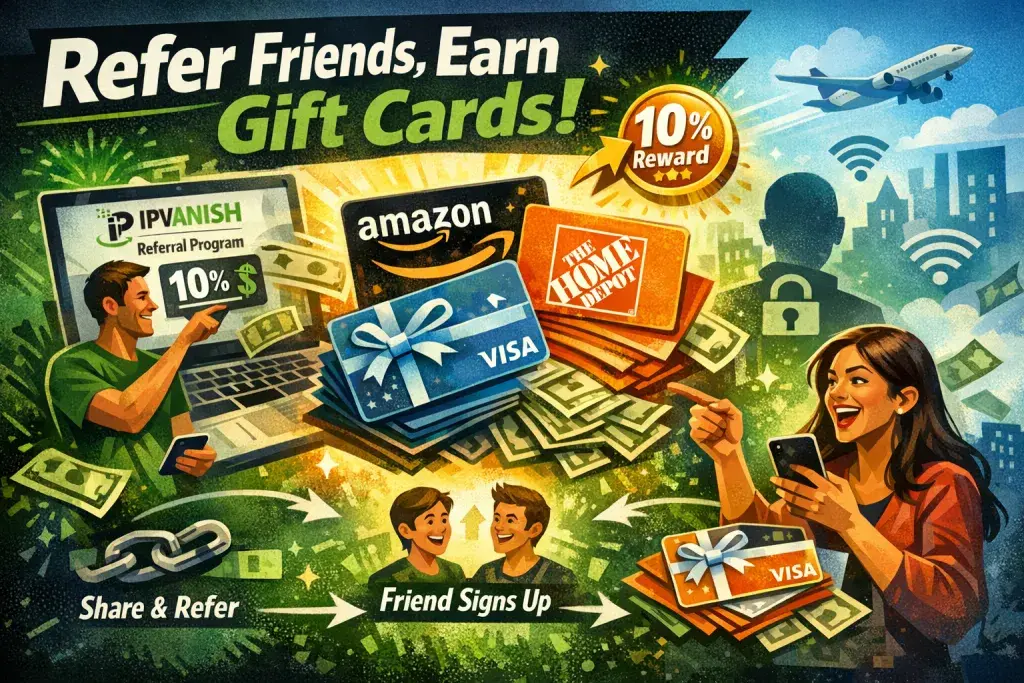
IPVanish has introduced its first refer-a-friend program, giving existing subscribers a cash-like reward for bringing in new customers and offering those new users a discount on sign-up. For a VPN market that often relies on free months and limited promotions, the shift to direct dollar rewards makes the offer stand out and turns privacy recommendations into something more tangible.
The program is available worldwide to current IPVanish customers. According to the company, users earn a reward equal to 10% of a referred friend’s net purchase value before tax, and those rewards can be exchanged for digital gift cards from retailers including Amazon and Home Depot.
A loyalty push in a crowded VPN market
VPN providers sell a simple promise: more privacy, more security, and in some cases access protection on public Wi-Fi or while traveling. But the market is crowded, pricing is competitive, and many services look similar to non-specialist buyers. That makes word-of-mouth unusually powerful. People often choose a VPN because someone they know already uses one and can explain why it matters.
IPVanish appears to be formalizing that behavior. “Loyal customers often mention how they introduced IPVanish to their friends, and we wanted to thank them for it,” said Subbu Sthanu, the company’s chief commercial officer. The structure also gives referred users a 10% discount on a new plan, creating an incentive on both sides of the transaction.
How the referral system works
Current subscribers can access the program through the My IPVanish account portal, where a new “Refer And Earn” tab generates a unique referral link tied to their account. That link can then be shared through email, messaging apps, or social platforms. If a friend clicks the link, signs up, and activates an IPVanish account, the referrer receives the reward automatically.
IPVanish has also added a tracking dashboard inside the same portal. That matters because referral schemes tend to work best when users can easily see whether a sign-up was recorded and what they have earned. Visibility reduces friction and makes the program feel less like a vague promotion and more like a predictable account feature.
Why this matters beyond a discount
The larger appeal is not just the gift card value. It is the way the program reframes digital privacy as something easier to recommend to friends and family who may still see VPNs as technical, unnecessary, or only useful for niche cases. A small financial incentive can prompt conversations that might not happen otherwise, especially as concerns about data exposure, account theft, and unsecured connections remain part of everyday internet use.
That does not mean all VPN services are interchangeable, or that a referral reward should be the main reason to choose one. Buyers still need to look at fundamentals such as device support, privacy policy, speed, usability, and whether the service has built a credible reputation over time. But from a consumer standpoint, IPVanish’s new offer is a notable sign of how subscription privacy tools are maturing: providers are no longer just competing on encryption claims and introductory pricing, but also on retention and customer advocacy.
What users should keep in mind
The reward scales with the value of the purchased plan, so higher-tier or longer subscriptions generate a larger return for the referrer. That creates a clear commercial incentive, and users should treat it as such. Recommending a privacy product to friends carries more weight than sharing a coupon for a generic streaming service, because it implies trust in how that company handles sensitive internet activity.
For IPVanish, the program is a customer acquisition tool. For subscribers, it is a chance to offset some of their own subscription cost through gift cards. For the wider VPN industry, it is another sign that privacy products are moving further into the mainstream consumer economy, where referrals, rewards, and retention strategies now sit alongside security features as part of the sales pitch.