
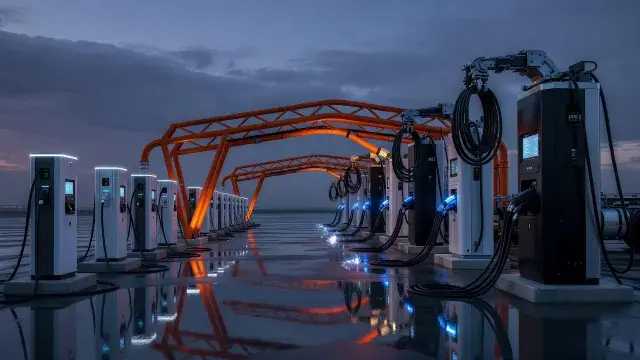
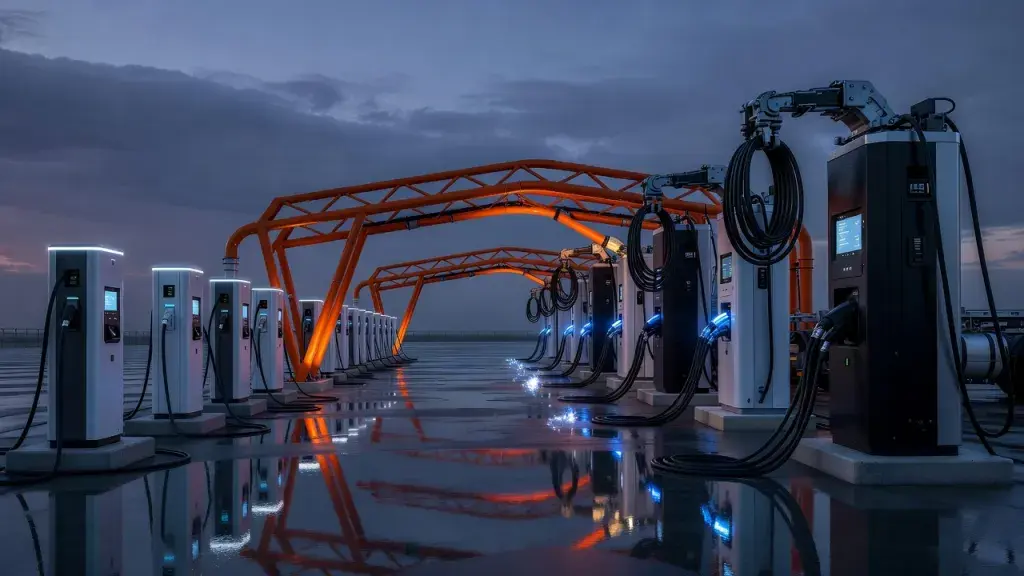
A single charging bay that can top up a passenger sedan and then, minutes later, deliver enough power to keep a long-haul truck on schedule - that's the practical promise behind Kempower's newly unveiled Mega Satellite Flex. The Finnish charging manufacturer introduced the dispenser this week at ACT Expo, during its Unplug & Recharge event for customers and partners, positioning it as the company's first unit capable of serving both the established CCS standard and the emerging Megawatt Charging System, or MCS.
The dual capability matters because electric transport is currently split across two incompatible power tiers. Passenger EVs, including newer 800-volt models that benefit from faster charging curves, rely on CCS, which the Mega Satellite Flex handles at up to 560 kW. Heavy-duty trucks, which need dramatically more energy delivered quickly to stay viable on long routes, require MCS, and this charger pushes up to 1.2 MW through that connector. For operators building out sites today, this kind of flexibility echoes a broader trend in consumer technology, where tools like a multi-device vpn let a single subscription secure a laptop, a phone, and a router simultaneously, rather than forcing users to buy separate protection for each device. Kempower is applying that same logic to physical charging infrastructure. multi-device vpn
Why a shared standard changes the economics
Building separate charging sites for cars and trucks is expensive and inefficient, particularly on highway corridors where land, grid connections, and permitting are already scarce. A site that serves both vehicle classes from day one avoids a second construction phase later, when truck charging demand grows to justify dedicated MCS infrastructure. That timing question has weighed on fleet operators and charging network builders alike: MCS adoption is still early, so a hybrid dispenser lets a site earn revenue from passenger vehicles now while remaining ready for heavy-duty traffic as truck electrification scales. Higher utilization from the outset is, in practical terms, the difference between a charging site that pays for itself quickly and one that sits underused for years.
Technical specifications and integration
The Mega Satellite Flex is built to handle serious current: up to 1,500 amps for MCS and 700 amps for CCS, with cable lengths of 5 meters for CCS and 2.7 meters for MCS to accommodate different vehicle geometries. An optional payment terminal allows for standalone commercial deployment. Kempower has also designed the unit to work within its existing distributed charging architecture, meaning operators already running Kempower systems can add the new dispenser without reengineering their power cabinets or site layout.
- CCS charging: up to 560 kW, 700 amps, 5-meter cable
- MCS charging: up to 1.2 MW, 1,500 amps, 2.7-meter cable
- Optional integrated payment terminal
- Compatible with Kempower's distributed charging system
What comes next
Kempower has set a North American and European launch for July 2026, giving fleet operators and charging network developers over a year to plan deployments around the new hardware. The rollout timeline aligns with the broader industry expectation that MCS adoption will accelerate as more truck manufacturers bring megawatt-capable models to market. Until that transition matures, dispensers built to serve both standards may prove to be the more realistic path for site operators trying to balance near-term revenue against a still-unfolding heavy-duty charging market.
